The single doc for the new customer template experience: the case, the five moments and the directions still to choose, the measurement problem, and the two config changes that need no design work. Grounded in 251,618 template-linked notes, live product walkthrough evidence, and PostHog baselines.
Wave 2 specCarlos McCoyDraft, ready for reviewUpdated 29 Jul 2026
The five picks are listed in open decisions. Once they are made, the winning screens get promoted into the consolidated build, which is one level deeper in fidelity and becomes the reference engineering builds against. Nothing needs to be picked from it today.
Templates are the signup pitch. The product doesn't keep it.
"We'll customize templates and features for your profession."Subtitle of the signup wizard's practice step, shown to every new customer. Screenshot below is from a fresh production signup on 14 July.
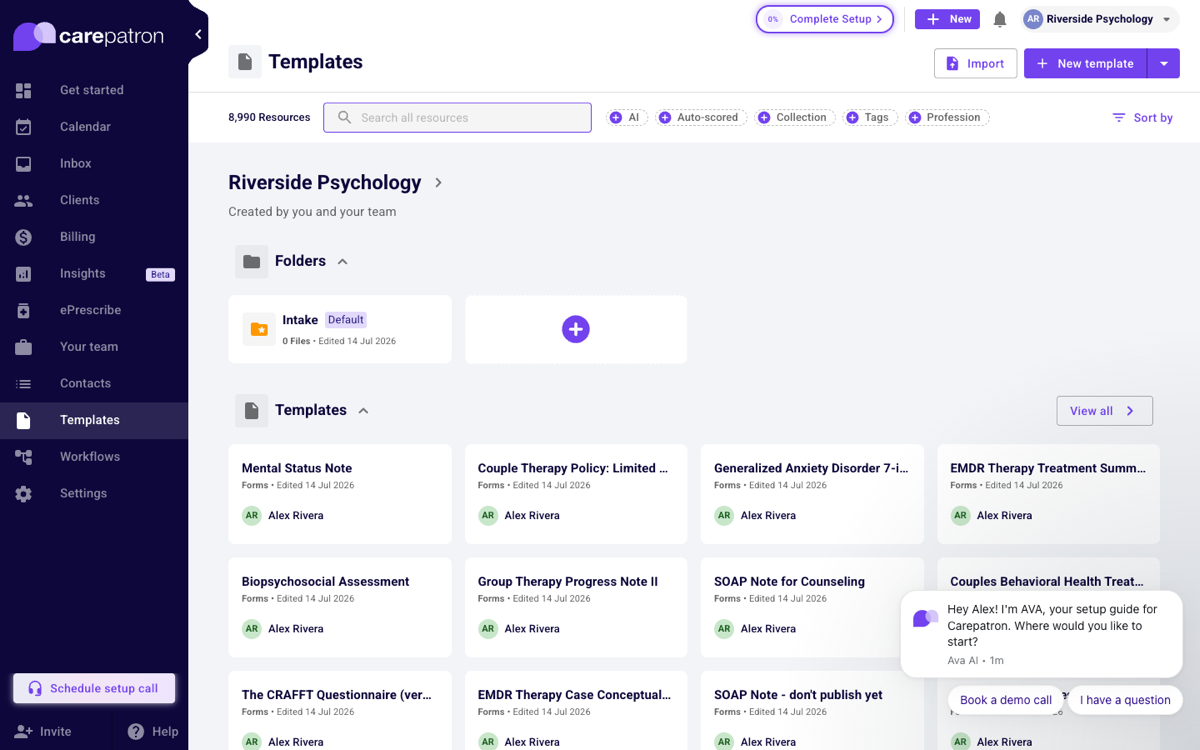
Here is what that customization amounts to for a new Psychology practice. The first visit to Templates opens with a count of 8,990 resources (8,970 on the live page today), a wall of roughly 60 pre-seeded templates, and below the fold, a community marketplace. There is no start here, no hierarchy, and no path.
First visit to Templates, minutes after signup. Every seeded card reads "Alex Rivera · Edited 14 Jul 2026". The brand new user appears to have authored 60 templates they have never seen. Note the third row: a template titled "SOAP Note - don't publish yet" ships in the default set.
59%named customising notes and templates the trickiest part of setup, the #1 answer. Billing was second at 36%
~4,932workspaces were template-active in a 10-week window, roughly 2 to 4% of registered
40%of new signups preview a template in their first 60 days. The traffic is already there
4.8%use template import, against 17.6% who say they're switching platforms
Sources: July 2026 setup survey, 13 of 22 responses, so small n and directional; production usage analysis by Tim, 13 Jul 2026 (251,618 template-linked notes over ~10 weeks, DB snapshot); PostHog, new signups over the last 60 days (n=4,681). Within mental health specifically, ~3.6% of registered workspaces were template-active (2,371 of 66,134). The adoption figures are new-signup cohort rates, share of signups doing the action at least once: preview 40%, update 19%, create 15%, import 4.8%, AI suggested 6%, AI applied 2%. The persona split is 74.5% greenfield and 17.6% switching from another tool (n=11,832, 90 days to 8 June).
Two more reasons this is now, not later: template curation is unassigned and was flagged as a blocker for onboarding in the 22 July product release meeting, and templates is the most complex piece of the 2.0 onboarding work, the one Jamie asked to be "really tidy".
What practitioners actually use
The usage data is unusually decisive.
SOAP is the universal note
Ranked #1 or #2 in every one of the seven profession groups. DAP is the clear second. Yet the Psychology default set contains no plain SOAP note, and five professions lack it entirely.
The same five admin documents travel together everywhere
Notice of Privacy Practices, credit card authorization, telehealth consent, release of information, financial responsibility. They appear in every group's top 20, always as a cluster. That is a packet, not five separate templates.
Library templates only get used as copies
Across the top 20 templates in all seven profession groups, all 140 rows are workspace-saved custom copies; no direct from-library use appears in this cut. Practitioners adopt templates by making them their own.
Mental health is half the volume
49.3% of all template-linked notes, and the only group where scored assessments (GAD-7, PHQ-9) are mainstream, at 340+ workspaces each.
Signatures are near universal
51 to 74% of form-notes carry a signature field in every group. Directly relevant to the sign-and-complete work in flight.
Against that, the current seeding is inverted: 64% of default slots are intakes, notes are an afterthought, and the packs are noisy. Dietetics, Functional Medicine and Health Coach receive identical copy-pasted sets. Personal Training ships 18 templates and not one is a note. The full gap analysis and the config fix are in ship now.
Goal and hypothesis
Goal: more new workspaces reach template activation in week one, meaning they add, import or save a template they will actually document with.
Hypothesis: a guided first landing plus a trustworthy importer lifts template activation, and template activation is a leading indicator of note-writing activation, conversion and retention. The downstream link is correlational and labelled as such wherever it is reported.
What a new customer hits today
Live production walkthrough, fresh Psychology workspace, 14 July. Five defects, each screenshotted.
False provenance
Seeded defaults are labeled "Created by you and your team", attributed to the user, edited today. It reads as a bug, not a gift. And the one structural element, a "Default" Intake folder that the first-run coach mark points at, ships with 0 files while the seeded intakes sit loose outside it.
The universal template is missing, then duplicated six times
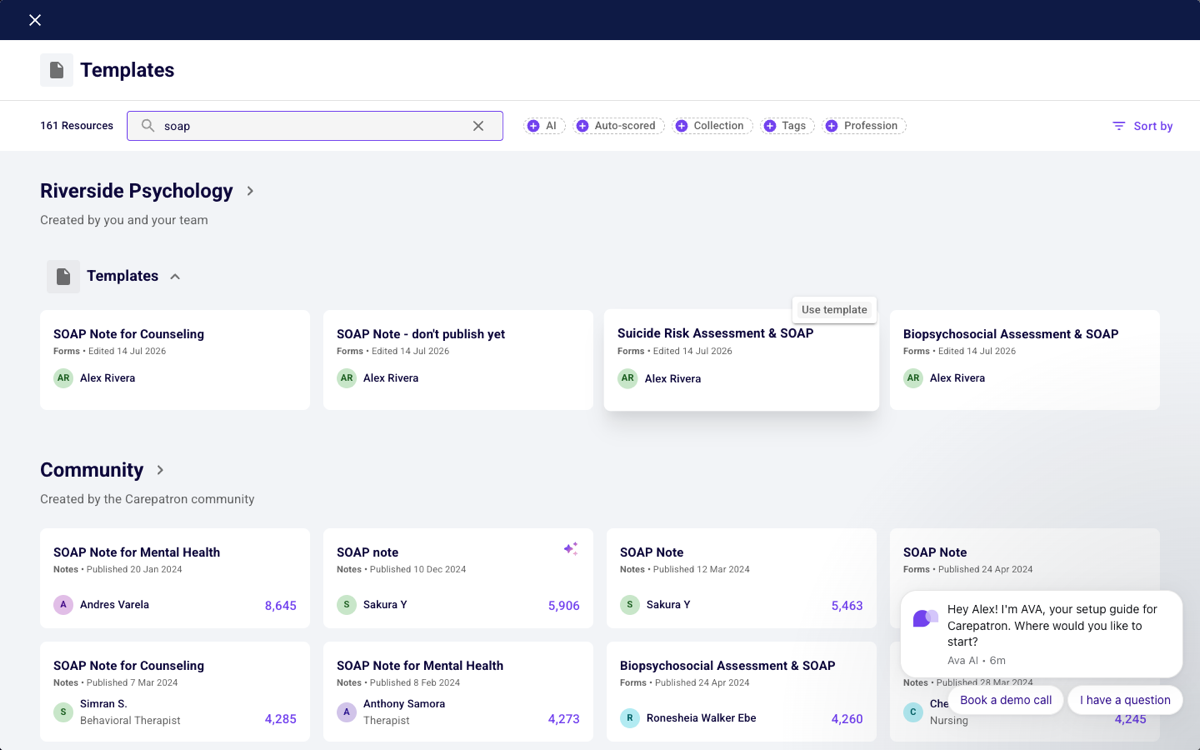
No plain SOAP note in the Psychology defaults. Searching community returns six or more near-identical SOAP notes with no canonical pick.
Point of use dead-ends
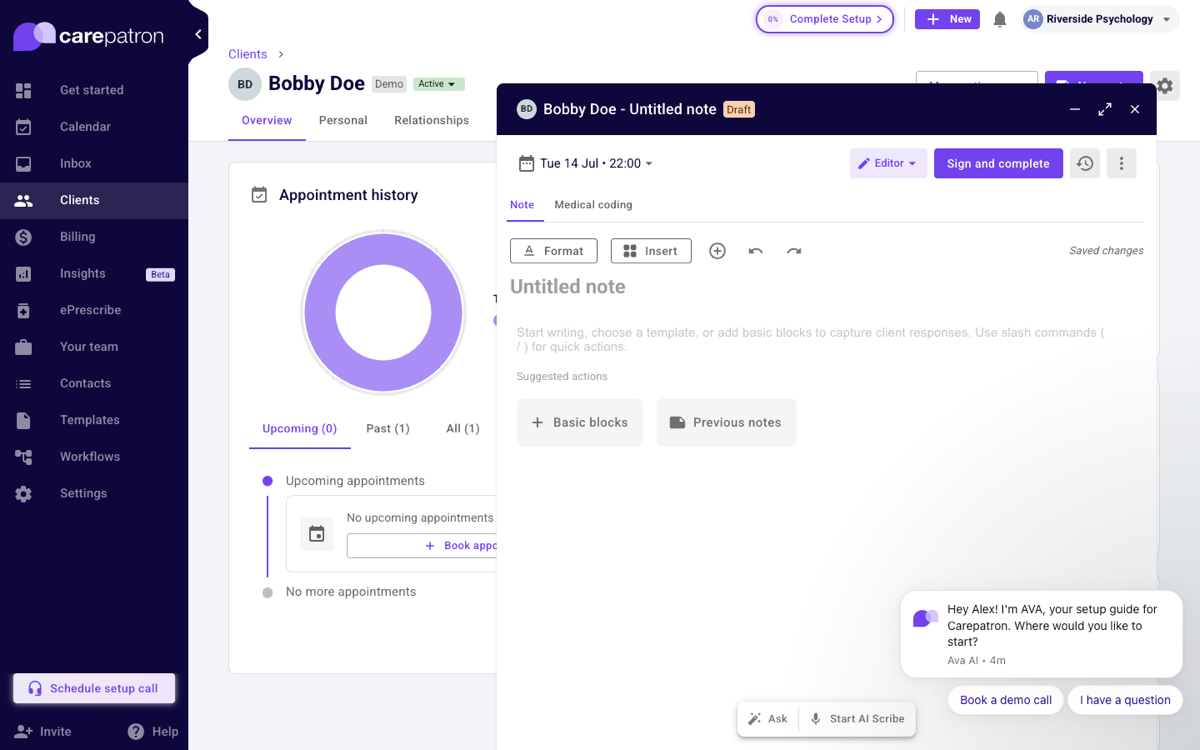
The note editor's own placeholder says "choose a template", but the suggested actions are Basic blocks and Previous notes, which a new user has none of. Typing /soap returns nothing. The real path is five steps through an unlabeled icon into a full screen browse of 9,010 resources.
Import can't carry the switcher journey
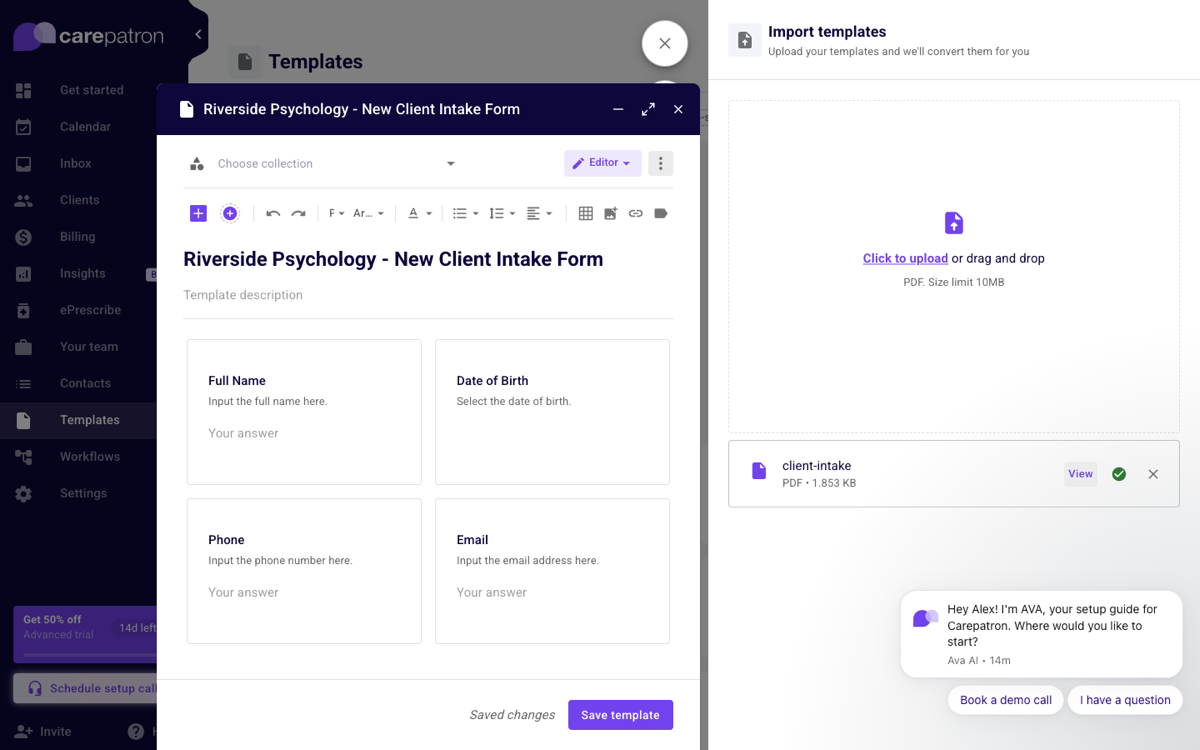
PDF only, 10MB, one file at a time. A switcher moving a practice has dozens of forms.
Import silently drops signature fields
The AI conversion is genuinely impressive: nine of nine fields extracted with correct types. But the signature line vanished with no warning. A switcher who doesn't notice ships a consent form clients can't sign.
Searching "soap" from the note flow. The workspace offers "SOAP Note - don't publish yet"; the community offers six competing SOAP notes. Nothing indicates which one to trust.The first note. The placeholder says "choose a template". The buttons don't.Import conversion of a test intake PDF. Field types inferred correctly, helper text auto-written. The signature and date line from the source PDF is simply gone.
The full annotated walkthrough (39 screenshots) is available on request.
The five moments
One story: your practice's paperwork, ready on arrival. Each moment below is one screen in the prototype, in order, with three genuinely different directions built for each.
1 · First landing
First visit to the Templates page. Replaces the 60-template pile with a suggested set of around ten drawn from what the data says gets used: SOAP, DAP and a progress note, the five admin documents that travel together in every group's top 20, and GAD-7 + PHQ-9 for mental health. Persona changes the lead, from data rather than a button. For the 17.6% switching, import becomes the hero ("Bring your templates with you") and the suggested set is the fallback; for the 74.5% greenfield, the suggested set leads and import sits below as a co-equal fork.
Locked on 22 July, shared by all three directions: the whole suggested set reviewed in one place, a checkbox per template grouped by destination folder, preview before you commit, one add action, and the edit-later promise stated plainly. Adding lands the user in the workspace, with no bridge modal.
Focused a quiet single-column checklist. Fastest to scan, closest to the daily product.
Gallery a visual card grid. Shows what the documents look like before anyone commits.
Editorial treats first setup as a moment. Large type, airy rows, a dark action bar that follows down the page.
The flagship for the 17.6% who are switching, and today it under-delivers: single PDF only, and it silently drops signature fields, which undercuts sign-and-complete.
Common to all three: multi-file upload (PDF and Word, up to 25 files), staged conversion with per-file results, a review step that names what was found, and a one-click fix when a signature line is detected but not converted. Converted templates land pre-filed into the same folders as the suggested set, so a switcher's workspace ends up as organised as a greenfield's.
Drawer stays where the importer lives today, on the right of the Templates page. Conversion runs inline and the page is never lost.
Wizard its own full-width flow: upload, convert, then review every file in a table before anything is saved.
In place no separate surface. Files land in the workspace as placeholder cards and fill in as they convert.
An under-the-hood importer upgrade was scheduled in the 22 July release meeting. This is the experience layer on top of it, so where that work landed needs confirming before build.
What the user sees immediately after adding. This is where opinion is most divided, so it is the pick worth the most discussion.
Banner land on the real page with the templates in place, one dismissible confirmation, then out of the way.
Spotlight confirmation plus a single obvious next step, aimed at editing, which is what the usage data says everyone does.
Next steps treats the payoff as a junction into the jobs templates unlock: sending the intake automatically when clients book, writing the first note, making them yours.
Once the workspace has content, the page should be organised around ownership rather than the library. It stops being a marketplace with your files on top.
Tabs "Your documentation" and "Explore community", plus a reasons-based suggestion rail.
Unified no tabs; your templates lead and community appears as a few reasoned suggestions and one quiet way in.
Search by month two the job is retrieval, not discovery, so search leads and browsing becomes a result.
Phase 2, AI personalisation. The suggested set is deterministic and ships without model risk. Once live, AI tailors it: practice name and branding pre-filled, fields adjusted to services and modality, and import conversion quality keeps improving. The baseline works without it; the AI layer makes it feel personal.
Deliberately not in scope
No new signup wizard steps (conversion-sensitive, recently slimmed), no setup-dashboard checklist changes (V3 just shipped), and no community marketplace redesign in this wave. The community stays where it is, one level down.
Ship now, no design needed
Two config-only changes, independently valuable and safe to move ahead of the design work.
Default template curation
Per-profession add and remove lists against the current defaults: 29 adds (SOAP, DAP and Progress core; Psychiatry gains GAD-7 and PHQ-9), 3 new builds (OT, PT, SLP SOAP), 104 removals (testimonial forms, minor-consent, one-off Spanish items). Review page: template-defaults.carlosmccoy.xyz.
Two traps. Edits must go by verified per-profession template ID, never by name, because two IDs are swapped between Massage therapy and Nursing in the current config. And the "SOAP Note - don't publish yet" draft seeded into wellness professions should come out immediately.
Default services
The same principle applied to the services auto-created at signup, which Jamie raised directly. The current config is largely placeholder: 103 of 144 services are exactly 50 minutes at $100, the file contains only two prices, 8 of 20 professions receive a list copied from another profession, and there are wrong-profession codes (Physical therapy carries a chiropractic manipulation code). The verified revision is 144 services down to 94 across 48 profession-safe lists on the full operational schema, with broad names, realistic durations, booking flags and concise client-facing descriptions. Review page and drop-in JSON: the services proposal.
One caveat, stated plainly. The prices in the proposal are informed estimates, not market data. They need verification before ship.
Measurement and instrumentation
Honest starting point: we largely cannot measure template usage in PostHog today.
create note carries no template property
The core activation moment, a note actually written from a template, is invisible in PostHog.
use template, choose template and choose public template are dead
Around 25 events total in 60 days. The events that should capture selection do not fire.
Template-linked notes are only visible in the database
Via used_template_info_snapshot, populated since about 5 May 2026. That is why the volume numbers on this page come from a DB snapshot rather than PostHog.
What we can baseline now
New-signup cohorts, first 60 days, share of signups doing the action at least once. Baselines are verified PostHog rates. The goal column is a proposal to pressure-test, not a committed target; real targets get set once instrumentation lands.
Metric (share of new signups)
Baseline
Proposed goal
Driven by
Note created from a template, within 7 days · primary
not measurable
instrument first
All five moments
Preview a template · preview template
40%
55%
Moments 1, 4
Update a template · update template
19%
30%
Moments 1, 5
Import a template · Imported template
4.8%
9%
Moment 2 (≈ half of switchers, up from ~1 in 4)
Create a template · create template · diagnostic
15%
watch
A good suggested set may reduce it; falling is fine if the primary rises
Instrumentation asks
Part of the build rather than optional. Without the first one there is no primary metric.
1 · Template identity on note creation
Which template, and its source: default, community, imported or scratch.
2 · First-landing events matching the Wave 1 pattern
first run prompt shown, action clicked, dismissed, with an item for templates.
3 · Importer funnel events
Files added, converted, needs review, fixed, saved. Turns the switcher journey into something readable end to end.
How we read it. A 2-week pre and post per Wave 1 practice, directional and confound-flagged, plus the modal-funnel view, which proved more reliable than cohort deltas in the Wave 1 ten-day read. The downstream hypothesis, that early template activation lifts week-4 retention and trial conversion, stays correlational until we can segment on the instrumented event, and gets labelled as such in any readout.
Open decisions
Five of these are one pick per screen, each answerable by flipping the toggle in the prototype. Three are not screen picks.
Decision
Options
What the pick settles
1 · First landing
Focused · Gallery · Editorial
How much of a moment first setup is allowed to be
2 · Import
Drawer · Wizard · In place
Whether the switcher ever leaves the Templates page
3 · Payoff
Banner · Spotlight · Next steps
Whether we push a next action or get out of the way
4 · Editor
Rail · Split · Slash
How visible the starting points are before you type
5 · A month in
Tabs · Unified · Search
Plus whether it ships in this wave or waits for the community-homepage overhaul
6 · Switcher detection
Re-add a signal · infer from behaviour
Signup v4 cut the current-platform question, so the persona lead in Moment 1 needs a source
7 · Naming
Current copy is "Suggested for therapists"
What we call the suggested set in-product
8 · Curation ownership
Needs a name
Who owns the default template and service lists as living config
Engineering asks
1 · Profession-filtered route or deep link into Templates
Still the number one gate, though the Profession filter chip already exists on the live page.
2 · Importer: multi-file, Word support, signature-field detection
With the review step. Needs a feasibility read against whatever the 22 July under-the-hood upgrade delivered.
3 · First-visit trigger and re-show rules
Show on first landings until acted on, stop once done, matching Wave 1's three-show cap.
Build behind a flag. Ship the two config companions first, since they are safe, fast and independently valuable. Then the first landing and the importer at 100%, with a 2-week pre and post, and a keep, iterate or kill call after the read.
Guardrail. Overall onboarding completion must not drop.
Decided already
Locked between 14 and 22 July, so not up for relitigation.
A curated set of around ten suggested templates, not per-profession piles
The Templates-page first visit is the moment, not a new setup-dashboard step
Checkbox review of the whole set
The edit-later promise on every arm
Adding lands you in the workspace
Import is a first-class fork and the switcher hero
Point-of-use suggestions live in the template editor, not the note editor
"Your documentation" and community are separate ideas
No "new client packet"
No "starter set" wording
No change-profession button, since signup already tells us
Deterministic suggestions first, AI personalisation as phase 2